

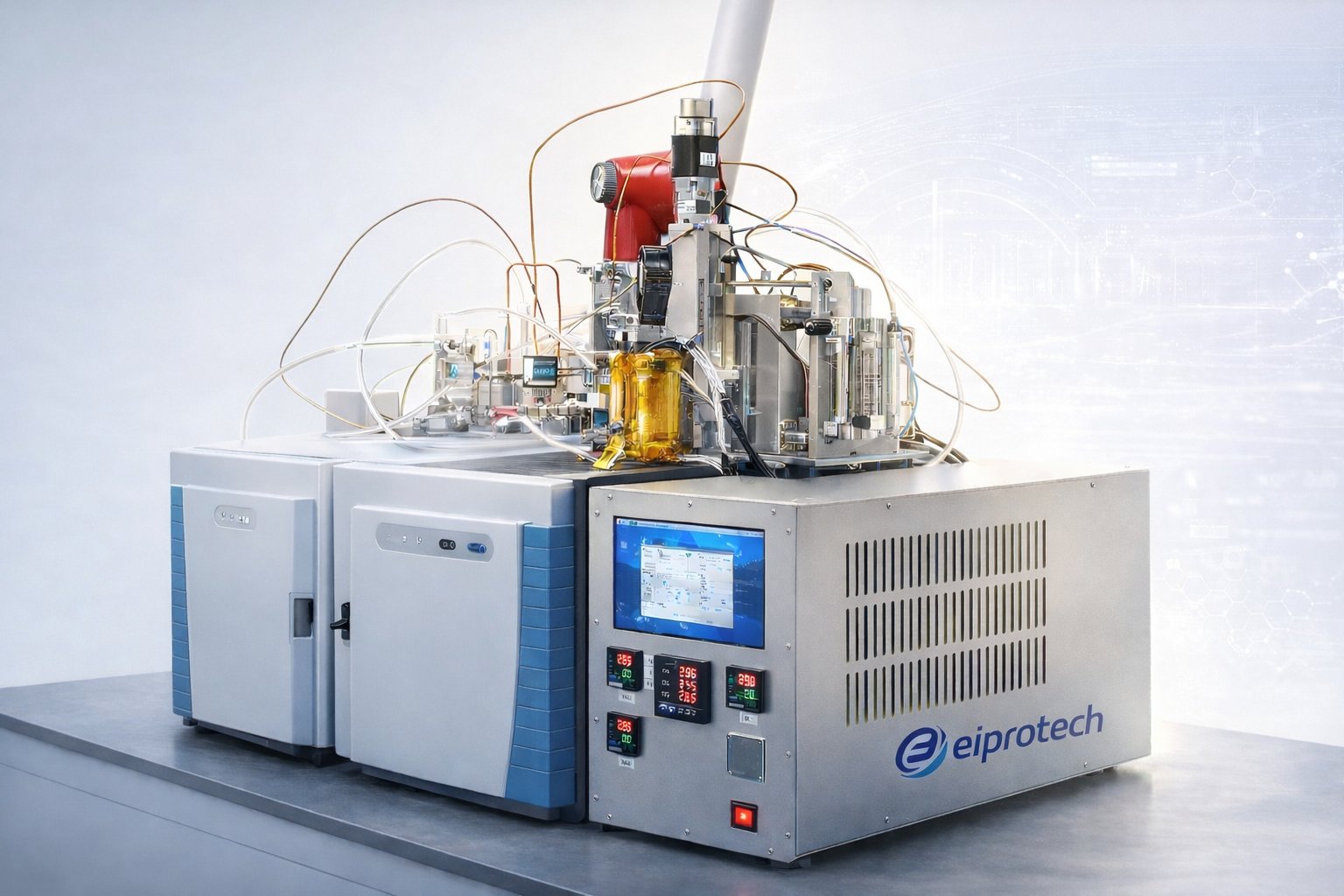
Aerosol Collection and Thermal desorption System (ACTS)
1. Technical Advantages
No GC modification required
Using a 10 cm injection needle + dual-septa interface, the system couples directly at the GC inlet region without drilling the GC oven or adding rigid transfer lines.
Soft-connection compatible design
A simple injection-needle interface replaces high-temperature multi-port valves and complex hard-plumbed connections, simplifying system integration and improving ease of maintenance.
Automated continuous operation
Aerosol sampling, thermal desorption, sample introduction, and GC/MS analysis are integrated into a complete automated sequence. Analysis from the previous cycle can proceed in parallel with sampling for the next cycle.
Rapid switching
The system supports fast switching between the front-end in-situ operating mode and conventional GC operation, allowing one GC/MS platform to serve both online monitoring and routine analysis.
2. Application Areas
Molecular-level online qualitative and quantitative analysis of PM2.5 / PM10 organic compounds
Designed for alkanes, fatty acids, PAHs, sugars, and other semi-volatile and low-volatility organic compounds in ambient particulate matter, the system enables online molecular-level identification of PM2.5 / PM10 organic components. It provides chemical composition information beyond what bulk mass monitoring can offer, supporting more refined pollution control as PM2.5 / PM10 levels continue to decline.
Source apportionment and process tracking
Based on time-series trends, co-variation patterns, and diurnal differences in molecular markers, the system helps identify traffic emissions, combustion sources, material emissions, and secondary formation processes, supporting source identification, mechanism analysis, and process tracking.
Indoor air, industrial park monitoring, and studies of pollutant emissions from materials
The system is suitable for automated continuous sampling–thermal desorption–GC/MS analysis in indoor environments, industrial parks, and material-emission scenarios. It can be used for long-term monitoring and characterization of volatilization and release patterns of alkanes, fatty acids, and emerging pollutants such as plasticizers.
An upgrade module for existing GC/MS systems
Without changing the GC structure, the system adds the capability of online PM2.5 / PM10 sampling + thermal desorption + molecular identification to existing GC/MS platforms in research laboratories, environmental monitoring institutions, and industrial labs, making it easier to extend conventional GC/MS systems into online particulate organic analysis.
Online detection of organic pollutants in water via spray enrichment
The system can be coupled with a spray-enrichment front-end to enrich trace organic pollutants from water and introduce them into the thermal desorption and GC/MS workflow, enabling online molecular-level detection and screening of trace organics in water.
Extension to online derivatization methods
An online derivatization module can be further integrated to expand GC/MS coverage to more polar compounds and oxygenated species.
3. Product Overview
The Aerosol Collection and Thermal Desorption System (ACTS) is a front-end system designed for online analysis of particulate organic matter and is intended to operate with conventional GC/MS systems. It integrates PM2.5 / PM10 collection, thermal desorption, carrier-gas transfer, and GC/MS sample introduction into an automated sequence, generating molecular-level chromatographic and mass spectrometric data for organic aerosol speciation, time-series tracking, and source apportionment.
The core innovation of ACTS lies in its soft-connection design, which uses a 10 cm injection needle + dual septa to interface the system with the GC inlet. During sampling, the needle tip remains in the sealed space between the two septa. During thermal desorption, the needle passes through the second septum into the GC liner for sample introduction. This design avoids the dependence of conventional TAG-type systems on high-temperature multi-port valves, rigid metal plumbing, and drilling through the GC oven wall.
4. System Configuration and Workflow

5. Key Performance Metrics

6. Comparison with TAG: Key Technical Parameters
TAG (Thermal Desorption Aerosol Gas Chromatograph) is one of the representative international technologies for online analysis of particulate organic matter, enabling thermal desorption, chromatographic separation, and molecular-level detection of aerosol organic compounds. Since ACTS is also designed for online particulate organic sampling and molecular identification, TAG serves as an appropriate benchmark for comparison. This helps illustrate the distinguishing features of ACTS in terms of system architecture, compatibility, automation, and analytical performance. Note: Product performance metrics and comparisons with TAG technical parameters are summarized based on Zhang et al., 2026, Aerosol Science and Technology.
Paper link:https://www.tandfonline.com/doi/full/10.1080/02786826.2026.2614032
To learn more, please CONTACT US.


 苏公网安备32058202010917号